Thursday, October 8, 2009

iPhone in Japan: Storming the Galapagos

Jason Lackey


I recently had the pleasure of spending some time in Japan, a wonderful wonderful place, particularly when you speak the language. Even if you don't speak Japanese, the country is very English friendly, most can speak at least a little bit and very welcoming. That said, reality is often far weirder and more unexpected than whatever you might imagine so being able to parse the protocol does add to the experience.

The picture above probably doesn't remind you much of an Apple store, does it? Then again, perhaps it shouldn't. It wouldn't really be Japan without attractive young women wearing Space: 1999 costumes pushing electronic gear in an overamped, overcrowded frenzy. I don't recall if this was Yodobashi Camera or some similar place, but it was in Akihabara, an odd and peculiar place at the very core of Geek Chic, a place where costume play, manga, anime, maid cafes and all the latest and greatest gadgets, widgets and toys all come together in a frantic mass of churning, burning consumption.

Apple's iPhone, when initially launched in Japan July 10, 2008, was regarded as a lukewarm success at best. It lacked features, it wasn't a portrait formfactor clamshell, no keyboard, no special animated messaging characters. A foreign oddity, a misborn, malformed freak unsuited to survival in the rarified air of the Japanese hyperphones, a gimpy cripple doomed to playground bullying and a life best characterized as traumatic, brutal and short.

Yep, even Wired got on that bandwagon.

However, as seen here: http://plusd.itmedia.co.jp/mobile/articles/0909/18/news086.html things are less grim for the feisty little scrapper from Cupertino than you might think.


Rankings courtesy of Wireless Watch Japan (thanks for a great site, Lars!)

Yes, of the Top 10 Handsets in Japan, 3 are iPhone variants, including the #1 slot. This is in spite of being on the SoftBank network, a newcomer in a deeply conservative land where many still view Toyota as being a car for an adult but a new, wet behind the ears company like Honda? Bit too new, best for ricer kids, car from an unproven company lacking in history and depth like that.

Wonder what would happen if it was available on DoCoMo and KDDI as well? In France, it seems the answer is about 40% market share.

It is not clear that this would happen in Japan, but it is clear what has happened with SoftBank since the launch of the iPhone.

7/2008: 19.1m total market 103.6m (18.44% share)
1/2009: 20.0m total market 105.8m (18.89% share)
9/2009: 21.1m total market 108.9m (19.37% share)


The Operators Strike Back: The Next Generation of App Stores (Part 3)

Dave Ginsburg

Last week I looked at appstores and smartphone OSs from the standpoint of the developer community, and what it implied for operator support. Today, I take the handset vendor’s perspective. At InnoPath, we call these the OEMs. More-so than an operator, who may need to support multiple platforms to reach all market segments, the handset vendor must take a more focused approach. This is especially true for the 2nd tier smartphone vendors who don’t have the economies of scale. Note the use of the word ‘smartphone.’ It is important, since some of these OEMs may have very large featurephone footprints, but may be marginal players at present in the Open OS space.

Given that RIM, Apple, and for the moment, Palm are vertically integrated, what is the best OS bet for an HTC, Nokia, Samsung, LG, Sony-Ericsson, or one of the up-and-coming Chinese vendors such as ZTE and Huawei? The first imperative is to move off legacy, proprietary platforms. Although these support web browsing, email, and are many times referred to as integrated devices, the application developer community just isn’t there. This could be said for Nucleus, BREW, and OEM proprietary OSs. Samsung, LG, and Sony-Ericsson are all known for devices in this category, though all three have announced their intent to migrate their product lines over the next few years.

The next question is then which of the Open OSs to support. We’ve got Windows Mobile, Symbian, Android, and flavors of Linux such as LiMo and Maemo. Reviewing current OS penetration on the chart below, Symbian, WM, and Android are all major players. In fact, at least one analyst, isuppli (http://www.isuppli.com/News/Pages/Reports-of-Windows-Mobiles-Death-are-Greatly-Exaggerated.aspx), takes a contrarian view to the prevailing wisdom and suggests that WM will take the #2 spot going forward on the strength of WM7 and vendor support. I’d personally also like to see webOS be made available to other vendors, as an option to Android. I don’t think Palm can build critical mass on their own in the time they have.
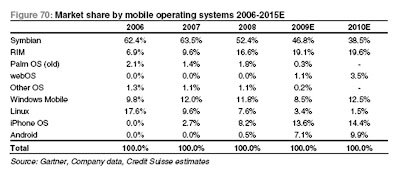
Windows Mobile is a bit of an enigma in the marketplace, not only due to confusion regarding 6.5 and 7.0 strategy, but around whether or not Microsoft will deliver an integrated platform. A recent article in Fierce Wireless by Mike Dano (http://www.fiercewireless.com/story/chill-through-windows-mobile/2009-09-24?utm_medium=nl&utm_source=internal) added fuel to the fire in regard to what is to become of Windows Mobile in the face of handset vendor defection. The flip side of the WM story are the rumored Pink devices (http://www.boygeniusreport.com/2009/09/23/images-of-microsofts-mass-market-turtle-and-pure-handsets-leak-out/) which could very well be the way that Microsoft regains vertically integrated control of the OS and hardware, successfully demonstrated by Apple and more recently, Palm.


But beyond absolute market share, what is important is application availability, a good proxy for what handsets a consumer will actually go out and buy. This sets the stage for future success, since everyone can build a phone with GPS and a big touchscreen. We’re already seeing the shift in OS dominance, from the legacy to the new, and based on applications and internet use. Just this week AdMob issued its latest update (http://metrics.admob.com/2009/09/august-2009-mobile-metrics-report/), showing just how the tide has turned. The iPhone had taken the #1 share (40%) from Symbian (34%), and both Android and webOS had strong showings at 7% and 4% respectively. RIM was at 8% and WM at 4%.

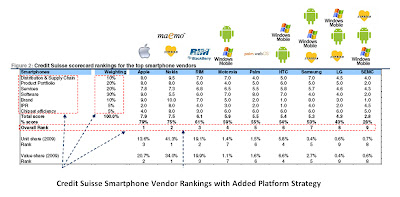
So, application availability should translate into a given OEM’s decision to support a platform (or not). Per the chart below, most vendors are fragmented in their Open OS support, even if they have only a few % of the global smartphone market. Nokia, the largest, is probably the best positioned of the ‘independents’ due to its Symbian experience and up-and-coming Maemo support. The real issue with Nokia has been its inability to counter Apple, even in its home territory of Western Europe. Motorola has taken a more focused course, placing most of its technical and marketing weight behind Android while continuing to support WM due to its strong enterprise footprint. This seems a reasonable approach and from all accounts, the CLIQ is a fine device. They’ve spent their time on matching the hardware to the OS. Unfortunately, this was not the case with HTC’s first generation Android G1, and issue addressed with the Hero.

HTC, best known for Windows Mobile devices, is now doubling down with Android. They can’t walk away from their WM legacy, but if the Hero is any indicator, their Android devices will be successful. That leaves LG, Samsung, and Sony-Ericsson, all three at the bottom of the table below, and all three fragmented in their Open OS strategy at the same time they are transitioning from legacy OSs.

Sony-Ericsson has stated that they must support all three – Symbian, Android, and Windows Mobile – to hit different geographies and market segments. But are they large enough to support the engineering and support base? Samsung and LG, though larger, are still less of a factor in the Open OS space. Samsung and LG, BTW, are also members of LiMo, as evidenced by Vodafone’s 360 announcement highlighting Samsung LiMO devices. The recommendation would be for all three vendors to take a strategic view of their market approach including tiers, geographies, and operator customers and then each prune at least one platform from their roadmap. All three have their own UI approaches. They could apply their engineering resources to perfecting this on one or two platforms, building a user experience that would begin to approach Apple.

As to the Chinese, I don’t see any reason for them to adopt anything other than Android, or in some cases, some other Linux variant. The logic when looking at application support, cost of development, and installed base just isn’t there. It permits them to better focus their development efforts and customer support, and by relying on an easily adaptable OS foundation they will be better able to apply their efforts towards differentiation (i.e., at the UI level as HTC has done with Sense on Android or TouchFlo3D on Windows Mobile) vs OS maintenance and other forms of reinventing the wheel.

Thursday, October 1, 2009

The Operators Strike Back: The Next Generation of App Stores (Part 2)

Dave Ginsburg

(This article originally appeared here on tmcnet.com 28 September 2009)

Last week I looked at the App Store phenomenon with a focus on how operators are introducing their next-generation portals.

This week, I’ll couple it with a perspective from the developer community, and what it means for the future success or lack thereof of the various Open OS platforms.

Next week I’ll fold in the handset vendor perspective, discussing whether they should spread their development across multiple platforms, or stick to one or two. Their future success could hang in the balance.

It goes without saying that Apple, in a relatively short time, has garnered the greatest mindshare amongst developers, independent of any perception as to the transparency with the application approval process. Apple has built sufficient momentum with regard to the types of applications available and cost points, including a wide variety of low-cost applications, try-and-buy, and ease of application discovery.

The Android Market in contrast is still on the upswing, and according to Admob, it has a ways to go to compete with Apple. The survey found that 55 percent of Android users have not yet downloaded an application from the store, in contrast to only 23 percent of iPhone users. Admob goes on to state that although the checkout process may be holding back subscribers, the real culprit is the lack of quality applications and mainstream software.

Applications are the outgrowth of a critical mass of developers, and as of August, 2009, the iPhone footprint was 40 times that of Android. More recently, Motorola and others have stated that application organization within the Market requires improvement. The new 1.6 release is expected to address some of these concerns.

The veteran, Symbian, claims the largest development community, but to its disadvantage, applications have traditionally been scattered, mostly handled by legacy operator platforms or 3rd parties. Nokia with its Ovi service and Sony Ericsson with its Play Now Arena are attempting to counter this, but their devices each only hold a portion of an operator’s network, and this varies by geography. In addition, users may not naturally gravitate to their handset vendor for applications as their primary financial relationship is with their operator.

On the operator front, efforts such as Vodafone’s 360 could help facilitate application awareness, but operator offerings do not build platform identity or directly address the developer issue.

At the same time, Symbian itself is in a transition to an open source model, and after the ^4 release, applications will no longer be backward compatible. This too will influence application development. Further confusing the Symbian issue is Nokia’s move to its Linux-based Maemo for some platforms and Sony-Ericsson dividing its loyalty across Symbian, Windows Mobile and Android. Neither vendor may therefore be considered as a proponent for the ultimate Symbian appstore.

Perhaps the Symbian Foundation will rise to the occasion, but at present the foundation’s Horizon initiative is more to act as a publisher to make sure that Symbian applications are available on 3rd party app stores such as Ovi, and the continued comfort of developers working within the framework of the foundation is unknown. This could create further fragmentation vs the centralized models of Apple and Android, as developers may need to maintain financial relationships with multiple operators and handset vendors. Additionally, one would expect that Nokia will begin to develop an application ecosystem around Malmo, influencing the prominence it places on Symbian.

Microsoft is only now launching its Marketplace with Windows Mobile 6.5, while the Blackberry App World launched at CTIA in Spring, 2009 enjoys moderate success. Both Samsung and LG also intend to launch stores in the near future, with both positioned as multi-OS in the same way as Ovi and Sony-Ericsson. Finally, the dark-horse platform with a great deal of promise is Palm’s WebOS, though the developer community is still quite small due to a minimal installed base. Nevertheless, in a short period of time and with minimal device penetration, it has garnered mindshare.

The graphic below helps clarify the various relationships. iPhone and Android developers need only maintain a financial relationship with their respective App Stores, and in the case of Android, will develop to a single, controlled ‘flavor’ despite support from different handset vendors (i.e., HTC, Samsung, Motorola, Sony-Ericsson). Developers for RIM take two paths.

The first is via the branded App Store, and the second is to the operator directly. Here, unless RIM’s App World acts as a strong broker, the developer may need to maintain a relationship with each operator. This of course won’t scale. However, development itself is still contained based on strong RIM device guidelines.

Development for Windows Mobile is more complicated. Although Microsoft has announced the Marketplace, it will take time to develop. The developer therefore must maintain a relationship with one or more operators, and at the same time the handset vendors who are launching their own storefronts. Design guidelines may also be more flexible than RIM or Apple, so a developer may need to be cognizant of handset vendor specific implementations. If successful, the Marketplace option could be the best path for the developer.

Symbian is more complex and fragmented, with no strong storefront or broker with the exception of the foundation’s Horizon. The developer at present must maintain a financial relationship with multiple handset vendors as well as with multiple operators. In addition, the various flavors of S60 result in software fragmentation, and the emergence of the foundation only adds to the confusion. Clearly, a better solution along the lines of the Windows Marketplace is required.

Here's a graphic display that I call "The Developer’s Conundrum: Application Development Ecosystems":


Separate from developer support, how do the various OSs stack up with regard to their UI, browser, and vendor support? Credit Suisse recently released a report (Smart Phones...Smarter Investments, Aug 31, 2009) looking at the smartphone market, as well as vendor and OS strengths and weaknesses. As expected, when taking the OS view, Apple is Number 1. Palm’s new webOS is 2nd, though limited in deployment, has some of the same advantages as to the UI and browser, as does Android, which is at 3. In fact, both platforms are close in the ranking and if market adoption was included, Android would be ahead. RIM, Symbian, and Windows Mobile all trail, within a few points of each other. The chart reaffirms the position that Android is the strongest ‘open’ OS (i.e., applications not controlled by a single entity as is the case with Apple). As I mentioned, next week I’ll look at how this compares to the vendor view. So what are the impacts on the developer community?

Ideally, an operator would embrace those platforms that combine large developer communities with ease of implementation. In addition to hardware design and usability, customers no longer wish to be limited to the traditional operator-controlled walled-garden and will seek out those devices with the widest application variety. Other than the iPhone, Android seems to be best positioned here for the mass market and in fact is a more open ecosystem. The success of Blackberry’s App World, Microsoft’s Marketplace, or the Symbian Horizon approach is too early to determine, though they could be more viable within an operator-controlled store. This is the approach Blackberry is taking with Verizon’s V CAST Apps Store as described last week.

Focusing on a small number of platforms will also help the operator or handset to focus its engineering, marketing, and support resources, and will also help to build loyalty by creating a critical mass of supporters . This is the path taken by the more successful operators, and given recent confusion over whether Verizon Wireless will or will not carry the Palm Pre, it is obviously top-of-mind.

Take a look at these Credit Suisse smartphone OS rankings:


Edited by Michael Dinan

Wednesday, September 23, 2009

The Operators Strike Back: The Next Generation of App Stores

A lot has been written recently regarding appstores and the role, or lack thereof, of the mobile operator. Regarding roles, it is not that operators have been unaware, or that they’ve not tried in this space. Every mobile operator has their ‘legacy’ store, and the term walled garden would be an understatement. Ever been to one? What Apple has done with their App Store, and to a lesser extent, Android with its Market, is that they have reset the bar on usability and convenience for the subscriber, as well as ease of development (and thus building a critical mass within the development community).

The cat is out of the bag, so to speak, with Apple, but operators still have the chance to play what they consider to be their rightful role. The key to success will be to balance the points mentioned above with their business model, a model different from the OS platform provider. It embraces the notion of an open and dynamic market for applications across platforms, and the role that the operator may play in brokering applications across the various open OSs supported within their network.

Verizon Wireless, based on their announcements, is taking this approach. As reported in Verizon to its smartphones: thou shalt have no other app store before mine (Jul 13, 2009), the operator will handle all billing and will have control over what 3rd party appstores and applications are made available on the handset out-of-the-box when its V CAST Apps Store launches before the end of 2009. They will revenue share with the application developers, and a subscriber will only need his or her single Verizon account for payments. A customer will still be able to access a 3rd party appstore directly but only after taking the initiative to download the specific portal software for the store.

In Verizon’s favor, the operator promises a more streamlined application approval process than that for Apple, and is pushing for a set of common standards that would permit application developers to more easily adapt their applications for multiple OSs. Verizon has traditionally maintained more control over the user experience, and this approach seems to align with this.

Verizon states that developers will retain 70% of the proceeds, which is equal to that of Apple but a change from what mobile operators took in the past. This is acknowledgement that Verizon understands this new world, a world very different from the very limited operator-driven software portals of the past. They understand that they either create a business model and user experience equal to Apple or Google, or get cut out of the equation. In addition, there are larger issues at play. As Shaw Wu in The Wall Street Journal pointed out, an effective appstore is also key to facilitating hardware sales. Users are no longer interested in just a static hardware platform. Just like the PC, they expect applications and capabilities to evolve.

Telefonica with its planned ‘mstore’ offering (http://saladeprensa.telefonica.es/jsp/base.jsp?contenido=/jsp/notasdeprensa/notadetalle.jsp&id=0&origen=portada&idm=eng&pais=1&elem=13765&titulo=Telef%F3nica%20launches%20'mstore',...) is also taking the same approach, leveraging Telefonica’s strong Movistar branding. What is interesting is that they plan to eventually launch across their operating companies, a user base of 200M. This will provide developers with a critical mass for development. They have described the organization structure, application pricing, but have not detailed platforms supported or how mstore will interact with the likes of Microsoft’s Marketplace or Android’s Market. Much like Verizon, Movistar-branded handsets will have the store application pre-installed.

These are just two current examples of operators getting into the game. Others will follow. But what OS platforms will succeed? Where should operators place their efforts? Next time around I’ll look at the operator appstore from the perspective of the OS platform, taking guesses on which will succeed based on the strength of their developer communities as opposed to only looking at OS features and hardware.

Standards: Conformity at Any Cost?

By Jason Lackey, Marketing Manager, Innopath Software

The world of technology is a fascinating one, filled with multiple competing dynamics.
On the one hand, innovation is the engine of capitalism and it is from innovation that competitive advantage is gained. On the other hand, in order to ensure that your widget plays nicely with other widgets (as few make enough of a solution to play alone in a vacuum) standards are necessary.

With standards, it is possible to do things like build a better browser that will show your favorite Web pages as they are intended to look, but faster and better. With standards one can do things like manage phones OTA (Over The Air) and make support less of a nightmare for your subscribers. With standards a lot of things are possible, but these possibilities come with a cost.

Standards come from standards bodies. Standards bodies tend to be populated by people from companies with a vested interest in some technology but the standards efforts tend not to be a central focus of those people who often have their "real" jobs to do when they are not in standards meetings. The various vendors represented will tend to have different perspectives, goals and desires and this can make progress very slow at times.
In the world of mobile device management, standards are relatively new, just like the technology. Of course, the technology came first and in the absence of standards vendors, by necessity, created proprietary protocols. The first wave of real standardization was from the Open Mobile Alliance in the form of OMA-CP, Client Provisioning protocol. While far from perfect, mostly due to being a one way write-only protocol, CP got the ball rolling and helped illustrate the value to device management.
Recognizing the shortcomings of fire and forget, OMA followed up on CP with OMA-DM, a bidirectional protocol that let you read as well as write, allowing the operator to get feedback after device management actions have been taken. I guess some folks decided that it would be useful to know that something had been fixed by means other than the person holding the device telling you that it had been fixed. I further suppose that folks figured it would be useful to be able to do things like a basic diagnostic ping on the phone.
All this is good, but as I mentioned before standards can move slowly and in many cases the standards don't keep up with the technology, which is where things like a "Standards+" approach come in. A vendor which owns both ends of a client/server solution can do things like support standards such as OMA-DM as a base, but also offer extensions and enhancements above and beyond the standards.
This gives the advantage of interoperability out of the box while also providing additional functionality. Back when the Model T was introduced, it could be said that existing standards for road construction called for dirt or gravel and the car worked fine on those roads. When a road was enhanced beyond being a rutted goat trail, beyond the standards of the day, the car didn't stop running, it ran better and provided a better end user experience.


Thursday, September 10, 2009

AT&T Device Redux

Dave Ginsburg

On the heels of a pulled BB Bold update (http://www.boygeniusreport.com/2009/09/04/att-pulls-blackberry-bold-software-upgrade/), rumors have it that they’ve now issued a recall on the recently launched Nokia Mural (http://www.boygeniusreport.com/2009/09/10/att-stops-all-sales-of-the-nokia-mural/) due to erroneous 2G vs 3G settings set at the factory. What is interesting is that the internal announcement hints of an available software update. Given that FOTA has proven to be both reliable and scalable at at least one other NA operator, the question is why AT&T doesn’t push an update to the impacted Murals. Is only a cabled update available and has Nokia not provided an OTA package due to the severity of the problem? Or, could FOTA have addressed the issue but the Mural is not FOTA capable? In this day and age, that seems hard to believe, but I’ve not seen evidence that FOTA is active on the handset. Any deeper insights into what could have been an easily prevented embarrassment?

Tuesday, September 8, 2009

Sweet Home rue de la Victoire

Telecoms is a wonderful industry although not without irony. For example, while we help our customers deliver better support to their subscribers remotely, over the air, it is also true when working on complex systems with many integration points and a lot of people involved, that it is often most effective to have a presence where your customers are. Evidently when buying multi-million euro solutions which are in the critical path of a core business function customers want to be able to get the vendor in the room and have a chat about things.

Thus, our latest office, in Paris:

InnoPath Software
52, rue de la Victoire, TMF Pôle
75009 Paris, France.
+ 33 1 56 53 63 60